燕雲傳奇 | Tales of Yanyun
Where Winds Meet RP CommunityHistory Based | Low Fantasy | Grounded Stories
Image: Along the River During the Qingming Festival (Zhang Zeduan, 1085-1145)
燕雲傳奇
About Us
Our name, 燕雲傳奇 Tales of Yanyun, is a reference to Where Winds Meet's original Chinese title, 燕雲十六聲.Where Winds Meet is titled Yanyun Shiliu Sheng (Sixteen Sounds of Yanyun) in Chinese. The name Yanyun is a reference to a historical region encompassing the Sixteen Prefectures, which was lost during the Five Dynasties and Ten Kingdoms period. The term Shiliu Sheng (Sixteen Sounds) alludes to a musical system comprising sixteen tones devised by Wang Pu, a minister of the Later Zhou dynasty. He had been commissioned by Emperor Shizong to write the musical treatise Lüzhun, so he incorporated folk culture and formed the framework. The sounds were thus composed of twelve tones that were classical and four tones that were used among the common people. The developers regarded the term as a metaphor for China's culture. The title was used by the developers to convey the background of the era. 1 2In the same way, this RP community is also focused on emphasizing stories of the common folk of the sixteen prefectures.We are looking for like-minded writers who enjoy:
- Stories focused on the common folk, "NPCs" rather than "heroes"
- Strictly low-fantasy, classic wuxia tropes, in a historically believable settingWe aim for historical realism, within reason. You do not need to be a scholar of Chinese history or Classical Chinese, however, we are looking for those with a willingness to learn, research, and write together!Note that prospective members are required to submit an application to join the community.
We have a responsibility to our members to make sure new members fit the grounded, historically realistic environment that is expected here.
The jianghu has a variety of colourful characters, some of whom choose to defy convention on purpose, with all the consequences it entails. As we strive to keep a balance between historical realism and creativity, we may allow unorthodox elements in characters, provided they are based on the writer's understanding of the culture, history, and genre, considered on a case-by-case basis during application.However, we draw the line on clearly magical characters: we do not accept, for example, yaoguai or immortals.
If this sort of RP setting excites you, then continue reading on!
燕雲傳奇
Rules
1. Be respectful of each other. Listen to and be patient with one another.
To learn from each other, overcome our differences, and build a community that can discuss difficult topics with respect and grace, we need to make space for each other. Interact with consideration and courtesy, and refrain from accusations and insults. Harassment, hostile, and aggressive behavior will not be tolerated—and will result in a warning, up to a ban, depending on severity.2. No bigotry, hate speech, or slurs of any kind.
This includes distasteful "jokes" and thinly veiled racist remarks. Depending on severity, will result in a warning or a ban.3. Keep IC (In Character) and OOC (Out Of Character) separate.
The character is not the writer, and vice versa. Good stories can be written when both writers are acutely aware of the line between writer and character.4. Discuss spoilers in the respective spoiler channels.
New people regularly find WWM and we wish to preserve the twists and turns for new players. Spoilers posted outside of spoiler channels may be deleted, up to admin discretion. Spoiler out art and screenshots with an explanation of the potential spoiler if posting in the creative channels.
E.g. Kaifeng spoilers
Art and RP posts that are posted must be drawn or written by yourself. Respect others and respond to RP posts with your own words.
In-game AI generated dances or poses and discussion of in-game AI NPC chatbots is allowed in the server.6. Admins have the final say.
Use the #tickets channel to report problematic behavior when needed. We will attempt to be as fair as possible, but we reserve the right to remove members without explanation in extreme cases.
If you've come this far and are still interested, please take a look at our community guidelines and lore!
燕雲傳奇
Tales of Yanyun RP Community Lore
The following is a condensed guide to Chinese culture and history that is relevant to the time period in which WWM is set. This serves as baseline knowledge we generally expect writers in this RP community to be somewhat familiar with. You are only required to read the bolded points, the non-bolded parts of the text simply goes into more detail on those points.We know it's a lot of information, even as a "brief general overview"! China has a thousands years long history and culture and this overview only scratches the surface of it.Please don't be daunted—we have a lot of leniency for being unfamiliar with the material, because we know how hard it can be to learn an entirely different culture and history. As long as you're willing to learn and be respectful (and in rare instances be gently corrected if something is blatantly incorrect), we're very happy to have folks who are interested in writing in the time period!We ourselves are not historians, just enthusiasts, so if we have gotten anything wrong, please by all means let us know and we'll be glad to fix the mistakes with your sources!Once again, you only need to read the bolded points! Feel free to skim the rest and read it at your leisure.
燕雲傳奇
Table of Contents
Chinese Language
A Brief Guide to Sinitic Naming Conventions
• Surname and Given Names
• Given Names
• 表字 - Courtesy name
• Romanization - Hanyu Pinyin and Wade-Giles system
• General Overview of Simplified vs Traditional Chinese Characters
Forms of Address
• Honorifics
• 成語 (chéngyǔ) | Idioms
Chinese History
What is Wuxia?
What is the Jianghu?
Time Period
• Key concepts and events preceeding the Five Dynasties and Ten Kingdoms
• The Five Dynasties and Ten Kingdoms
Social Structure and Classes in Ancient China
• Social Structure and Classes
• Literacy
Spirituality, Religion, and Schools of Philosophy
• Ancestral Worship
• Confucianism
• Daoism
• Buddhism
Sexuality
Other
Units of Measurement
• Time
• Length/Mass
• Currency
Clothing, Hairstyle, and Makeup
Where Winds Meet Sects
A Note on Ethnicity, Colourism, and Cultural Sensitivity
A Final Note
燕雲傳奇
Chinese Language
A Brief Guide to Sinitic Naming Conventions
姓名 - Surname and Given NamesUnlike Western names, Chinese names follow the structure of [surname] + [given names], with single character surname + double character given names being the most common naming constructions. Historically, surnames are typically inherited through the patrilineal line, and women do not change their surnames upon marriage. A person from the Zhou (周) family, named Wenjun (文俊) would be called Zhou Wenjun.Double character surnames, while rarer than single-character surnames, exist. Some examples are 上官 (Shàngguān); 司馬 (Sīmǎ); and 諸葛 (Zhūgě). Non-Han Chinese people may also have surnames transilaterated into Chinese that contain more than one character, such as 完顏 (Wányán) of Jurchen, 耶律 (Yēlǜ) of Khitan, and 獨孤 (Dúgū) of Xianbei people.Common Chinese surnames can be found in the Hundred Family Surnames.名 — Given namesIn choosing given names, there are several naming taboos observed, though the most common—and most important—is to avoid using ancestors' names, as it is considered going against generational hierarchy, and therefore disrespectful.Given names are more commonly chosen to reflect parents' wishes on their child's futures, and characters are chosen according to the baby's gender, although many characters are gender-neutral.Some common characters for a boy's name are:杰 - jié - outstanding, distinguished睿 - ruì - astute, intelligent健 - jiàn - health正 - zhéng - righteous謙 - qiān - modest俊 - jún - eminent, handsome熹 - xī - bright, warmMore to find here.Common characters for girls are:琳 - lín - jade美 - měi - beautiful娴 - xián - refined兰 - lán - orchid雅 - yǎ - elegant英 - yīng - blossom慧 - huì - intelligentMore to find here.However, historically, it was more common to name children based on the birth order within the family or the clan among commoners—for example, the third child of the Zhou family may be called simply, 周三 (Zhou San), or Zhou Three.Meanwhile, the upper class and the educated may have a generation poem, a sequence of characters forming a poem specific to each family's lineage, and a child may receive a character to his or her given name that reflects his or her place in the lineage. The other characters may be chosen based on auspiciousness, stroke number, and sound.表字 - Courtesy namePrior to the 20th century, men of the upper class, scholars, and officials typically receive a formal 'courtesy name' (表字, biǎo zì) upon reaching adulthood (around age 20) or have entered official life. Courtesy names are used among peers, whereas given names are used by themselves and their elders.
In general, if the given name is only one character, then their full name is typically used. E.g. the eldest son of the Zheng family, named Zheng Xiao, is never addressed as simply 'Xiao' or 'Zheng' as it is very unnatural in speech—the person would either be called Zheng-(honorific) by non-kin, 哥哥 / 大哥 (dàgē) by his siblings, and 曉兒 (Xiao'er) only by parents or elders of the family. Very close, older family members and close friends may call him 阿曉 (A Xiao) as a term of endearment or to denote intimacy.Full names (family name + given name) are also commonly used even when the person has a 2 character given name, such as Zheng Lianhua. It's more likely for them to addressed as "Zheng Lianhua" and not "Lianhua" except with family and close friends.When making nicknames, typically the second character of a given name is used instead of the first. E.g. in the case of Zheng Lianhua, they might be nicknamed, "Huahua" or "Xiao(little) Hua" and NOT "Lianlian" or "Xiao Lian." This is likely due to generational names, because usually families did not only have just one child and they would probably have siblings or cousins who all share the first character. For example, a group of siblings called Zheng Lianhua, Zheng Lianzhao, and Zhen Lianyu. Their nicknames may be, respectively, "Huahua," "Zhaozhao," and "Yuyu" and NOT "Lianlian," "Lianlian," and... "Lianlian."
Romanization - Hanyu Pinyin and Wade-Giles systemThere are several systems Chinese language romanization. The most commonly found today in naming romanizations are Hanyu Pinyin, or simply pinyin, the Wade-Giles system, and Tongyong Pinyin. Pinyin is most commonly used in mainland China, whereas transcription of legal names using the Wade-Giles system is more commonly found in Taiwan.Some examples of romanization of Chinese surnames using pinyin and Wade-Giles, compared side by side:Hanzi Pinyin Wade-Giles 陈 Chen Ch'en 許 Xu Hsü 趙 Zhao ChaoWhile this group does not have a restriction on which romanization system should be used for character names, it is advisable to not mix the systems together—e.g., Wei Cheng instead of Wei Tsung (Wei: pinyin, Tsung is Wade-Giles).
General Overview of Simplified vs Traditional Chinese CharactersThe Chinese written language does not use an alphabet like many romantic languages, instead using a pictorial script which represents each individual word (and is not linked to sound). Because of this, learning Chinese requires one to memorize at least 3000-5000 different characters in order to be able to read somewhat fluently. The lack of words being linked to sound but rather to meaning allows Chinese today to be able to read writing from thousands of years ago, even though the ancients would have pronounced the words differently compared to modern times. Japanese are also able to communicate with Chinese directly through writing by simply using Kanji (Chinese Characters).Traditional Chinese Characters were used up until 1956, when the CCP in China simplified the characters in an attempt to increase the literacy rate of the population. At the time the literacy rate was very low, due to difficulty in memorizing so many characters. Some parts of the world still use Traditional Chinese Characters, most notably Taiwan, Hong Kong, and parts of the USA where Chinese had immigrated before 1956.Chinese is traditionally written top to bottom, right to left, columns right to left, like raindrops falling from the sky. Signs were written right to left (you can see this in WWM itself). In an attempt to Westernize during the Cultural Revolution, the Mainland China writing system was changed to resemble Western writing systems and now is primarily left to right, top to bottom.Some examples of Traditional and Simplified Characters, compared side by side:Traditional Simplified Pinyin 開封 开封 Kaifeng 這個 这个 zhege (translation: "this")燕雲十六聲 燕云十六声 WWM CN nameThis group does not have any restriction on the usage of Traditional or Simplified characters—and many overlap—but for full historical accuracy Traditional characters are recommended.
Forms of Address
In Chinese culture, some of the terms of address for family members (“brother/sister”, “uncle/aunt”, etc…) can also be used for friends, neighbors, and even strangers.Naturally, these terms appear very frequently in Wuxia, Xianxia & Xuanhuan novels, and it can be confusing for new readers to see the characters refer to anyone and everyone using these kinship terms.The important thing to remember is that just because a character calls someone else their “brother”, “aunt”, etc… it doesn’t necessarily mean they’re blood-related. It’s possible that the speaker is just being polite or affectionate by using these terms.Pinyin Hanzi Translation
Shushu 叔叔 Uncle
Ayi 阿姨 Aunt
Xiongdi 兄弟 Brother
Dage 大哥 Big Brother
Ge/Gege/Xiong 哥 / 哥哥 / 兄 Elder Brother
Di/Didi 弟 / 弟弟 Younger Brother
Jiemei 姐妹 Sister
Dajie 大姐 Big Sister
Jie/Jiejie 姐 / 姐姐 Elder Sister
Mei/Meimei 妹 / 妹妹 Younger Sister
Xiaojie 小姐 MissPlease refer to the rest of the article here! It is not too long and is a very good beginner's guide to terms of address in wuxia.
For ease of use in English-speaking RP, English equivalents of the honorific may be used - 'young master' in lieu of 公子 (Gōngzǐ) or 少爺 (Shàoyé), 'miss' instead of 姑娘 (Gūniáng), brother/sister/uncle instead of 哥哥 / 姐姐 / 叔叔 / 舅舅。Note: Typically, a younger person will never refer to someone older than them by name. Instead, they will usually call them by a title or honorific. For example, a younger son will call his older brother "哥哥" (older brother)or "(given name)哥". The older brother can call their younger brother by their given name or "弟弟" (younger brother), but the younger brother can NEVER call the older brother by only his given name. The same applies for anyone elder—the younger person can NEVER call the older person by their name, without a title or honorific attached to it. It is disrespectful for the younger person to call anyone older than them by name and Chinese society places great emphasis on honouring the elderly.
Honorifics
Honorifics were used in almost all aspects of life in ancient China.In general, there are five distinct categories of honorific language:- Respectful Language (敬辭; Jìngcí), which is used when referring to others to show deference and politeness.
- Humble Language (謙辭; Qiāncí), which is used when referring to oneself in a self-deprecating manner to show humbleness and humility.
- Indirect Language (婉辭; Wǎncí), which is the use of euphemisms or tactful language to approach sensitive topics and show respect.
- Courteous Language (客套語; Kètàoyǔ), which employs praising and laudatory words or phrases with the intent to flatter the addressee.
- Elegant Language (雅語; Yáyǔ), which employs elegant and beautiful expressions and words in lieu of more casual words and phrases to describe people, objects, actions or concepts. It is often used on occasions where casual language may be deemed inappropriate. Due to the lack of equivalent expressions in English, translated phrases often do not convey the same sense of beauty or elegance. 1When RPing, it can add a bit of flavour to attempt to use honorifics according to your character's status. However, even us admins are not entirely familiar with the system (due to it being very complex) so don't fret too much about being overly "correct."We do, however, allow characters to respond ICly to how they perceive they are being addressed (politely, not politely enough, etc) but that will be up to the individual writer and their familiarity with honorifics. We would recommend discussing with your RP partner(s) OOCly if you are unsure whether or not they meant to have their character make a slight on your character due to their usage of honorifics. As always, communication is key!Please at least generally familiarize yourself with the various honorifics in the article here (skimming is fine). Of particular note is the section on referring to oneself in the third person, a practice that was common at the time:
https://en.wikipedia.org/wiki/Chinese_honorifics
成語 (chéngyǔ) | Idioms
成語 (chéngyǔ), loosely translated as "Idioms", are four character expressions that typically condense the message, morals, or wisdom of a story, myth, or historical event. Chengyu are used by everyone, however, the more chengyu one knows, the more "learned" one usually is—it is therefore more common to see scholars and officials using chengyu frequently, as compared to a farmer.Some examples of chengyu:
Often the four characters reflect the moral behind the story rather than the story itself. For example, the phrase "破釜沉舟" (pò fǔ chén zhōu, lit: "break the pots and sink the ships") is based on a historical account where the general Xiang Yu ordered his troops to destroy all cooking utensils and boats after crossing a river into the enemy's territory. He won the battle because of this "no-retreat" strategy. Thus, the idiom is used as a verb phrase with the meaning "to make an all-out effort to achieve success by the deliberate removal of recourse or backup."Another example is 瓜田李下 (guātián lǐxià 'melon field, beneath the plums'), whose meaning relates to the appearance of misconduct or impropriety. It is derived from an excerpt of a Han-era poem (樂府詩《君子行》, Yuèfǔ Shī "Jūnzǐ Xíng"). The poem includes the lines 'don't adjust your shoes in a melon field, and don't tidy your hat under the plum trees' (瓜田不納履,李下不整冠, guā tián bù nà lǚ, lǐ xià bù zhěng guān), admonishing the reader to avoid situations where, however innocent, he might be suspected of doing wrong. The idiom is impossible to understand without the background knowledge of the origin of the phrase. 1A more in depth explanation of Chengyu can be found here.In RP, it can help show the learning level of a character based on how much they use chengyu in conversation. But learning chengyu can be difficult for even native speakers, so don't feel like it's a requirement, just optional flavour!
燕雲傳奇
Chinese History
What is Wuxia?
Wuxia (武侠) is a genre of Chinese low-fantasy fiction featuring the stories of martial artists who follow a code of chivalry in ancient China. Wuxia is composed of two characters: 武 (wǔ), meaning 'martial' or 'military', and 侠 (xiá), meaning 'hero' or 'chivalrous.' While these stories tend to heavily feature knights-errants ('yóu xiá', 游侠), martial arts, and fighting, the core of the genre sits on the strict, unwritten code of chivalry, or 侠, these knight-errants follow. Wuxia's code of chivalry is an amalgamation of Chinese philosophical thoughts. While some argue that the root of 侠 found itself in Mozi's teaching during the Warring States period, its common core attributes of benevolence ('ren', 仁), loyalty ('zhōng' 忠), courage ('yǒng' 勇), and righteousness ('yì' 義) are derived from Confucian values and Daoist ideals of individual freedom. A knight-errant, or youxia, in wuxia stories seek to uphold justice, care for the weak, maintain his or her personal integrity, driven by a sense of moral duty to the world, rather than personal desires or ambition. Tension or conflict may arise from individual desire clashing against 侠。 Other related genres are:- Xianxia (仙侠) — xianxia stories share a core of 侠,but adds explicit supernatural elements, magic, and immortals (仙)。While wuxia can be grounded or somewhat fantastical, wuxia does not have an element of cultivating to immortality.
- Xuanhuan (玄幻) — Xuanhuan, or 'mysterious fantasy' blends Chinese cultural elements with that of other genres, such as high fantasy or sci-fi.This group aims to tell stories strictly within the wuxia genre, focusing on tales of the common people, and the everyday heroes that rose among them.
What is the Jianghu?
Jianghu (江湖;jiānghú; lit. 'rivers and lakes') refers to a society that exists parallel to, and outside of the mainstream imperial society in which the wuxia story is set. Jianghu is not merely a place where these knights-errants wander; the jianghu is made up of the the common people—merchants, craftsmen, wanderers—and outlaws who live separate from imperial law.For a more detailed explanation, please see:What is Jianghu? - WuxiasocietyOn the Jianghu, and xia, translated from a Chinese player's perspectiveAn excellent videoform summary
Time Period
The game Where Winds Meet, or 燕雲十六聲 (The Sixteen Sounds of Yanyun), takes place at the end of the Five Dynasties and Ten Kingdoms era (907-979 CE), to the beginning of the Northern Song dynasty (960 CE). The Five Dynasties and Ten Kingdoms era saw a succession of five dynastic states in northern China and ten concurrent kingdoms in southern China, culminating in the founding of the Northern Song dynasty by a Later Zhou military general, Zhao Kuangyin, later Emperor Taizu of Song.This section aims to provide a very brief overview of the era's history, covering the decline of the Tang dynasty after the Huang Chao rebellion in 874-884 CE, the establishment of Later Liang (907-923 CE) following the abdication of Emperor Ai of Tang, the succession of states and dynasties in the Five Dynasties and Ten Kingdoms, the founding of Northern Song, and historical figures who appeared or were mentioned in the game.DISCLAIMERPlease note that the game mixes real historical events and figures with fiction. Several names mentioned in this section may be found in the game, alive when they were noted as deceased, or portrayed in manner that sparked controversy even among the Chinese player base.The lore staff responsible for this section is not a scholar of Chinese history, nor claims any expertise in Chinese history—simply an enthusiast of both history and the game lore, who attempts to assemble a very brief introduction to one of the most chaotic periods in Chinese history towards English-speaking players. Therefore, events and figures will be presented as neutrally as possible according to the source documents available, avoiding interpretation or analysis.Since this is only an extremely short overview meant to familiarise writers to the key events, figures, and timeline surrounding the setting of the game, many inaccuracies and gaps may be present. Links to resources will be provided at the end, and writers are encouraged to read further at their own discretion.Key concepts and events preceeding the Five Dynasties and Ten Kingdoms節度使 - Jiedushi - Regional military governor or regional commander established in 711 CE in Tang Dynasty, authorized with maintenance of defense within several prefectures, collect taxes, and promote and appoint subordinates. In the later years of the Tang dynasty, as it declines after the An Lushan rebellion, and later, Huang Chao rebellion (874-884), these military governors—or warlords—would emerge as key players in the beginning and succession of the Five Dynasties era.Huang Chao Rebellion (874-884)The end of the An Lushan rebellion in 755-763 CE had weakened the Tang Dynasty, leaving behind large areas of Tang territory controlled by jiedushi. This political decline, coupled by economic decline, was made worse by corruption and incompetence in the late Xiantong era of Emperor Yizong of Tang. Despite famine caused by droughts and floods, the Tang government increased taxes to fund Emperor Yizong's lavish lifestyle and military campaigns. This led to mounting resentment from the common people, and rebellions rose during the mid-9th century, many of which were composed of impoverished farmers, landowners, merchants, and salt smugglers.In 874, Huang Chao and Wang Xianzhi, both originally salt smugglers and soldiers, raised an army and rebelled against Tang government. Huang Chao's rebel army pushed imperial forces all the way to Luoyang and Chang'an, forcing Emperor Xizong to abandon Chang'an. He had briefly captured Luoyang and Chang'an, declaring himself emperor of a new Qi dynasty, until his army was defeated by the combined forces of Tang generals and a Shatuo Turk general Li Keyong in 883.Huang Chao was murdered by his nephew Lin Yan in 884, thus ending the Huang Chao rebellion, but leaving Tang dynasty to disintegrate into independent territories.Abolishment of the Tang dynasty (907), and establishment of Later Liang (907-923)A severely weakened Tang dynasty continued to remain to see the reigns of two emperors: Emperor Zhaozong, and his son, who reigned as a puppet emperor.During his reign, Emperor Zhaozong launched campaigns against three military governors: Li Keyong, Chen Jingxuan, and Li Maozhen. The failure of these campaigns allowed the rise of a major warlord Zhu Wen, who eventually seized control and murdered Emperor Zhaozong, putting his thirteen year old son Li Zuo, later known as Li Chu, as a puppet emperor. In 907, three years after the enthronement of Li Zuo, Zhu Wen forced him to abdicate, dissolving the Tang dynasty and beginning the Five Dynasties era proper by the establishment of Later Liang.Li Chu was murdered in his mansion in Cao Prefecture under Zhu Wen's order, by poisoning. He was conferred the posthumous title Emperor Ai.The Five Dynasties and Ten KingdomsFive Dynasties:1. Later Liang (907-923)Established by Zhu Wen, later Emperor Taizu of Later Liang, formerly a warlord allied with the Huang Chao rebels who defected to Tang and suppressed the rebellion; awarded the Xuanwu Jiedushi (regional military governor) title for this role. In 904, he executed Emperor Zhaozong of Tang, and made his son, Emperor Ai, a puppet emperor in 904-907. In 907, Emperor Ai of Tang was forced to abdicate the throne to Zhu Wen, ending the Tang dynasty and starting Later Liang.2. Later Tang (923-936)The Shatuo-Turk led Later Tang was established by Li Cunxu in 923, after conquering Later Liang. Li Cunxu was the son of Li Keyong, the jiedushi of Hedong circuit, and another key figure in suppressing the Huang Chao rebellion. In 925, Li Cunxu conquered Former Shu, annexing its territory.3. Later Jin (937-947)In 936, Later Tang faced rebellion from one of its generals, Shi Jingtang. In the rebellion, Shi Jingtang offered the region of the Sixteen Prefectures of Yan-Yun (燕雲十六州 - Yānyún Shíliù Zhōu), an area that encompasses modern-day Beijing, Tianjin, parts of northern Hebei and Shanxi provinces north of the Hai river, to the Khitan-led Liao dynasty in exchange for military aid to overthrow Li Congke, the fourth and last Emperor of Later Tang.Later Jin was derided as a puppet state controlled by Khitan Liao, and Shi Jingtang styled himself the "son emperor" of Liao Emperor Taizong, whom he referred to as "father emperor."His successor, Shi Chonggui, defied the Liao dynasty, leading to invasion and destruction of Later Jin in 947. Among the battles fought in the invasion of Liao against Later Jin, a key battle known as the Battle of Zhongdu Bridge** or the Battle of Hutuo River, resulted in the surrender of the Northern Expeditionary Army of Later Jin to Khitan Liao.However, despite the fall of Later Jin, Liao's Emperor Taizong was unable to control the territory he had conquered, and retreated his forces to the Sixteen Prefectures. Along the way, he died of an illness, sparking succession crisis in the Liao dynasty.*This battle was mentioned in the Qinghe part of the game, tied to the lore surrounding the General's Shrine. To avoid spoilers, details have been removed and links are provided below for further reading.4. Later Han (947-951)The combination of the fall of Later Jin and the succession crisis in Liao gave way to a power vacuum, eventually filled by the military governor of Bingzhou, Liu Zhiyuan. Later Han was overthrown two years later when Assistant Military Commissioner Guo Wei staged a coup during the reign of Liu Chengyou, establishing the Later Zhou dynasty.The remnants of Later Han retreated to Shanxi and established the Northern Han kingdom, eventually reunited under Song dynasty in 979.5. Later Zhou (951-960)Guo Wei ascended the throne as Emperor of Later Zhou in 951; he died after a three-year reign from illness, and was succeeded by his nephew Chai Rong, who changed his name to Guo Rong. Chai Rong—later known as Emperor Shizong of Later Zhou—was considered an able, effective ruler. Shortly after he ascended the throne, the Northern Han tried to atttack Later Zhou while transfer of power was still ongoing to the new Emperor; Chai Rong personally led his troops in the Battle of Gaoping, pushing the Northern Han army all the way to Taiyuan.Later Zhou under Chai Rong's rule dispatched three expeditions against Southern Tang and succeeded; he recovered many areas that had been ceded to the Khitan by the later Jin dynasty. In 959, he launched an expedition to recapture the Sixteen Prefectures of Yan and Yun; he had captured Yingzhou, Mozhou, Yijin Pass, Waqiao Pass, and Gaoyang Pass in succession. Later that year, he fell ill and retreated—in June, he was dead, succeeded by his seven-year old son Chai Zongxun.The Old History of the Five Dynasties described Emperor Shizong as a brilliant, courageous ruler, who had managed to recapture lost territories within a span of eight years.An oft-remembered quote from Emperor Shizong of Later Zhou is:"十年開拓天下,十年養百姓,十年致太平"("I will use ten years to conquer the world, ten years to foster stability, and ten years to enrich the people.")The Chenqiao Mutiny and the Ascent of the Song dynastyBefore the death of Emperor Shizong, he appointed one of his generals, Zhou Kuangyin, as the Commander of Palace Guards, in charge of the armies of the Palace Guards. The following year, Zhao Kuangyin was ordered to defend the border against the allied forces of Northern Han and Khitan Liao—however, on the third day, a coup occurred at Chenqiao Post Station, 20 km northeast of Kaifeng.In an event known as the Chenqiao Mutiny, the soldiers draped a yellow robe—the colour of the Emperor's robe, strictly allowed to be worn only by the Emperor—over Zhao Kuangyin the following morning. The army returned to the capital, and Emperor Gong of Later Zhou abdicated; ending the era of Later Zhou and establishing the Song dynasty under Zhou Kuangyin, later known as Emperor Taizu of Song.Note: Chinese sources seem to debate whether the Chenqiao Mutiny was deliberately staged by Zhao Kuangyin himself or by his soldiers, however he's also noted to have been 'reluctant' to take the throne.Ten Kingdoms:1. Yang Wu (907-937)
2. Wuyue (907-978)
3. Min (909-945)
4. Ma Chu (907–951)
5. Southern Han (917–971)
6. Former Shu (907–925)
7. Later Shu (934–965)
8. Jingnan (924–963)
9. Southern Tang (937–976)
10. Northern Han (951–979)Further Reading/Resources:In CN: Overview of the Five Dynasties and Ten Kingdoms, Bilibili video and its English 'transcription' - Territorial Maps of The Five Dynasties and Ten KingdomsSPOILER ALERT Battle of Zhongdu BridgeSPOILER ALERT Battle of Zhongdu Bridge, continuedChinese drama enthusiasts may be interested in the drama 太平年 (Swords Into Plowshares), that tells the story of the factions involved in the Five Dynasties era, particularly focussing on the Wuyue kingdom to the South; the drama starts around 945 CE. It is available on streaming site Viki and YouTube—the first twenty episodes aired in the latter are free to watch.
Social Structure and Classes in Ancient China
According to the traditional Confucian view, society is made up of four classes: government officials, farmers, artisans and merchants.This scheme exalts public officials as shepherds of the flock; it esteems farmers as the economic basis for the whole of society; and recognizes artisans as being of some use; but it denigrates merchants as being greedy, parasites on the rest of society, making themselves rich by making others poor. 1A comprehensive, accessible explanation of each class can be found here (highly recommend reading this): https://www.historyskills.com/classroom/year-7/year-7-chinese-society-reading/
And here in more detail: https://timemaps.com/encyclopedia/ancient-china-society/#classUnlike typical European nobility, one could raise their status by passing the Imperial Examination and becoming a scholar-official. Thus, society greatly valued and placed enormous importance on being educated, because you could—by merit alone—raise the status of your family into nobility.However, in reality, usually only those with the resources to do so—typically those already part of the gentry—could properly prepare their sons for the Imperial Examination. But because it was merit based, a poor farmer's son could also pass the exam and raise his family into the gentry. This is why you will see many NPCs in WWM encouraging their children to study hard. The mentality that education and learning are vitally important applied throughout most of Chinese society (and modern Chinese society as well).On merchants, note that Chinese society saw them in a rather negative light. Since they did not create anything themselves and only sold what others created, they were seen as lazy, deceitful, and greedy. However, this does not mean people were hostile to merchants, just that they were looked down upon and were not held in high esteem like the educated.
Literacy
It is unclear how literate people were in ancient China. A common consensus seems to be that literacy rate was not very high among men. This comment (with sources) goes into literacy rate in more detail. For women it was even lower because of Confucian teachings. Women were neglected when it came to education and opportunities, as most resources in that area were funneled towards sons:Before 1949, more than 90 percent of the women in China were illiterate. 1For the purposes of RP however, this community will go by these guidelines:
- Those of nobility and the scholar-official class are highly likely to be literate. Women of this class are also likely to be literate.
- Farmers, peasants, soldiers who came from peasant backgrounds, etc are more likely to not be literate, especially peasant women.
- When creating your character, if they are literate, consider why, how, and where they received their education.
- 90% of women being illiterate is a very high amount, and we understand wanting to write a female character who is literate. WWM seems to have many literate women, so we prefer to be more lenient in this regard, as long as the backstory of the character contains a thoughtful explanation.
Spirituality, Religions, and Philosophy
In Ancient Chinese society, spirituality is rooted in a prehistoric tradition of animism that evolved into folk religious practices. A central concept in its theology and cosmology is 天 (tiãn; 'heaven')—and a supreme deity called 上帝 (shàngdì; 'primordial deity'- also called 天老爷 'tiãn lǎo yé'; 老天爷 'lǎo tiãn yé'). Tian may encompass a realm of gods and spirits; an independent, supreme force presiding over gods and human beings; a force that could bring order, calm, catastrophe, and punishment; and the source from which an imperial family obtained its right to rule (the Mandate of Heaven).Principal to the practice of these beliefs include the veneration of 神 (shén; 'spirits/deities') - which may include heavenly gods, earthly gods, spirits of every day objects (e.g. Kitchen God/Stove God); historical heroes and legends venerated as deities.While the three teachings of Confucianism, Buddhism, and Daoism would later play a major role in shaping Chinese society, these folk religious practices, such as ancestral and deity worship, are near inseparable from Chinese culture. It is rooted in family and civic life, permeating nearly all aspects of social life and are still practiced even today, regardless of an individual's religious affiliation.Read more here.
Ancestral WorshipIn general, ancestor worship refers to practices of paying veneration to deceased ancestors. The fundamental cosmology that underpins ancestor worship is the perpetuation of family line that is believed to be unbroken by death. The deceased family members, or ancestors, thus keep a strong tie with living family members, and they are highly respected by descendants due to their seniority and supernatural power of blessing. SourceThe practice of ancestor worship is reflected in the continued obeisance of living family members towards the revered deceased ancestors. Living family members install an ancestral tablet at a household altar; they lit incense daily, and offerings such as foods, beverages, and spirit money are given twice a week.On special occasions such as the Qingming Festival (Tomb-sweeping Day; first day of the fifth solar term of the Chinese lunisolar calendar) and the Hungry Ghost Festival (15th Day of the 7th month of the Chinese calendar ), family members lit incense, offer food and drink and joss paper; during Qingming, families visit ancestral tombs to clean the gravesites and make their offering.
ConfucianismConfucianism, a set of moral, ethical, and political philosophy rooted in the teaching of Confucius, emphasizes personal ethics and relationship between individuals and government, with the aim of being a person of noble moral character (君子 - jūnzi) and fostering a harmonious society.The core ethical values in Confucianism are:> Traditional | Simplified - pinyin - translation
> - 仁 - rén - benevolence
> - 義 | 义 - yì - righteousness
> - 禮 | 礼 - lǐ - propriety
> - 智 - zhì - wisdom
> - 信 - xìn - faithfulnessThe Five Key Relationships (Wu Lun 五伦): Confucianism outlines five primary relationships that form the fabric of society:1. Ruler and Subject
2. Parent and Child
3. Husband and Wife
4. Elder Sibling and Younger Sibling
5. Friend and FriendUnder this model, the ruler must treat the subject with propriety (lǐ), and the subject must be faithful to their duties. Fathers provide for, and show affection to his son, and his son observes filial piety (孝 - xiào)* in return; husbands understand and respect their wives, and wives understand, honor, and help their husbands; mutual respect and care are fostered between siblings, where the elder sibling cares for, and sets an example for the younger sibling, and the younger sibling should respect the elder; while friends trust each other as a social group without blood ties.Women, on the other hand, were expected to follow the three obediences and four virtues ( 三從四德 - sāncóng sìdé).*On Filial Piety:Confucianism regard filial piety as the root of all virtue, and the beginning of the obeisance of filial piety is by taking care of one's body, which is received from one's parents, and should not be injured or maimed or treated carelessly. For this reason, people in ancient China kept their hair long, and tattoos were looked down upon as as a brand for criminals. Short hair likewise was also a punishment for criminals. This does not extend to Buddhist monks who shaved their head for religious reasons.Confucianism would undergo a revival under the Song dynasty, in a movement termed Neo-Confucianism [道學 - dào xué].Further reading on the historical background of Neo-Confucianism could be found here.
MohismMohism is a school of philosophy founded by Mozi (475-391 BCE), during the Warring States period. The core tenets of Mohism centers around a consequentialist ethic emphasizing impartial care (兼愛 - jiān ài - 'lit. universal love'), anti-aggression (非攻 - fēi gōng - 'non-aggression'), frugality in rituals and condemnation of luxury; meritocracy (尚贤 - shàng xián; lit. 'esteeming the worthy'); and obedience to 天 (Heaven), along with reverence towards the ghosts and spirits worshipped in Chinese folk religion. The Early phase of the Mohist school focuses on ethics, political philosophy, and religion; the Later phase, which existed around 300-200 BCE, was concerned with siege defence, logic, and scientific treatises. This made Mohism unique among the school of philosophies that rose during the era: they were engineers and philosophers, whose canon text, the 墨經 (mò jīng), taught not only ethics and politis, but also geometry, optics, mechanics, logic, and military siege defense.Mohism was a popular school of thought during the Warring States era rivalling Confucianism, however, it disappeared suddenly sometime during the early second century BCE. Although Mohism disappeared as an independent school of philosopy, much of its teaching was absorbed into Daoism.In the game, the martial arts sect 墨山道 , or Mohist Hill, is likely based on the Later Mohist phase of the school.More on Mohism here.
BuddhismBuddhism was introduced to China around the 200 BCE, during the Han dynasty, and developed significantly during the early Tang empire, at one point gaining more followers than Daoism. An example of the massive Buddhist influence on this time period can be seen in the thousands of Buddhist statues in Longmen Grottoes, in modern-day Henan province, the development of which was promoted by Empress Wu Zetian (reigning as female emperor of the Wu Zhou dynasty, r. 690-750). The reach and influence of Buddhism declined following the Huichuang Persecution of Buddhism (會昌毀佛), initiated by Emperor Wuzong of the Tang Dynasty (r. 840-846). Buddhism, then, did not regain footing until the Song dynasty.In Where Winds Meet, the Huichang Persecution of Buddhism was the event that initiated the founding of the Midnight Blades sect by NPC Monk Liaowu, which operates on a twisted understanding of karma-vipaka.More on Chinese Buddhism here.
Sexuality
While the concept of 'homosexuality' and 'heterosexuality' as they are understood today—as an inherent part of an individual's identity—did not exist in Imperial China, historical records of the concept of same-sex romance and sexual practice exist, mostly among men, and rulers/officials. Records of same-sex sexual practices among commoners and women are scant in comparison, however, as long as an individual marries the opposite sex in accordance to the Confucian societal demand to continue the family line, same-sex practice did not carry a negative moral ('sinful') connotation the way it does among Western Judeochristian societies, and the Three Teachings of Imperial China (Confucianism, Buddhism, Daoism) did not condemn the practice of same-sex behaviour.The most popular term for homosexuality in Imperial China, 斷袖之癖 (duàn xiù zhī pǐ - 'cut sleeves') came from a record of Emperor Ai of Han (~4 BCE), who favoured a minor official Dong Xian; their relationship was explicitly intimate. The term itself came from a story where, upon finding Dong Xian asleep on his long sleeves, the Emperor decided to cut his sleeves instead of waking his lover.Another surviving record on societal view of male-male sexual relationship survived in a passage written in the Liu Song dynasty (3rd century CE), which said:“All the gentlemen and officials esteemed it. All men in the realm followed this fashion to the extent that husbands and wives were estranged. Resentful unmarried women became jealous.”Male-male same sex practice continued through the Tang and Song dynasty, where male prostitution replaced earlier dynasty's class-based hierarchical patronage from a powerful ruler/official to a man of a minor rank.Female-Female Same-sex PracticesBy contrast, records of female-female same sex practices are rare, partially owing to the relative absence of personal freedom accorded to women. One surviving record from the Han dynasty noted a practice among palace women with over sexual undertones, called 对食 (duì shí), where "palace women attach themselves as husband and wife, and are intensely jealous of each other."Sources:
1 2, 3, 4
Hinsch, Bret. Passions of the Cut Sleeve. 1990.
燕雲傳奇
Other
Units of Measurement
TimeAncient Chinese timekeeping structure divides a day into twelve periods, each consisting of a single unit that corresponds to two hours in modern timekeeping, called a 時辰 (shíchén), and further broken down into quarter-hour units called 刻 (ké).Each period of time is named after one of the twelve Earthly Branches.Branch - Hourszǐ - 子 - rat - 11 pm - 1 am.
Zǐ shí is divided into two: 下子时 (xià zí shí) or 夜子时 (yè zí shí)- 11 pm to midnight 子正 (zí zhèng) - midnight to 1 amchǒu - 丑 - ox - 1 am to 3 amyín - 寅 - tiger- 3 am to 5 ammāo - 卯 - rabbit - 5 am to 7 amchén - 辰 - dragon - 7 am to 9 amsì - 巳 - snake - 9 am to 11 amwǔ - 午 - horse - 11 am to 1 pmwèi - 未 - sheep - 1 pm to 3 pmshēn - 申 - monkey - 3 pm to 5 pmyǒu - 酉 - chicken - 5 pm to 7 pmxū - 戌 - dog - 7 pm to 9 pmhài - 亥 - pig - 9 pm to 11 pmSource: 1,2Since one-hourly time period was not yet known then, hours in between the range of time in each time period is still referred to by its corresponding period; e.g. 8 am is still 辰時 (chén shí, hour of the Dragon), 6 pm is referred to as 戌時 (xū shí, hour of the Dog). One hour is half a shíchén—a common phrase to describe one hour in historical or wuxia media is "一炷香時間 " (yī zhù xiāng shí jiān - 'one incense stick of time')* . It is also possible to note specific time by nth-ké of the x hour; for example, 10 pm is the fourth ké of the hài hour.*Note: one incense stick of time is an arbitrary timekeeping system that can range from 30 minutes to one hour, depending on the length and size of the incense stick. Source.Timekeeping ObjectsIn the absence of mechanical clocks, water clocks , sun dials, and incense-burning) was used to tell the time. Sun dials were the earliest timekeeping object used, dating back as early as the Han dynasty, and relied on the shadow cast by the position of the sun to tell the time.Water clocks, or clepsydra, uses dripping water from one container to a lower container to mark the passing of time. By the Tang dynasty, water clocks placed in the imperial palace had reached accuracy to about a quarter of an hour. However, despite the accuracy, water clocks are not accessible to just anyone, much less commoners; this device is typically placed in the city center or government offices, and was checked daily by a designated person.Another method is to use a special kind of incense, called the 更香 (Gèng xiāng), formulated specifically to burn for two hours (a shíchén). This method was simple and inexpensive, and commonly used by night watchmen in a city to remind them to strike the gong to mark the time for every period of the night watch (更次 - gèng cì, approximately two hours).Cities had a drum tower and a bell tower where bell was rung during the day, and the drum was struck at night to announce time; even if a commoner did not possess objects to keep time themselves, they could tell the time from the sound of bells and drums in the city.Source
LengthTraditional units of length are the 尺 (chi), bu (步), and li (里). While the length of these units has varied over time, the measurement used in this time setting would correspond to the standard used during the Song dynasty.1 尺 (chǐ) = 0.2700 metres1 步 (bù) = 5 尺 = 1.3500 metres1 里 (lǐ) = 360 bu = 486 metres.
MassMass units are denoted by 斤 (jīn), or catty, and further broken down into 兩 (liǎng), 錢 (qián),and 分 (fēn).1 jīn = 633 grams1 liǎng = 40 grams = 1/16 jin1 qián = 4 grams = 1/160 jin1 fēn = 0.4 grams = 1/1600 jin.Further reading: Chinese units of measurement
CurrencyThere are three basic units of currency used:- 1 standard square-holed copper coin;
- 1 tael of silver
- 1 tael of gold.The exchange value between these units of currencies fluctuated frequently, and each dynasty used varying monetary units. During the Tang dynasty, Emperor Gaozu minted a currency called the 開元通寶 (Kāiyuán tōngbǎo), a square-hold copper coin inscribed 開元通寶 vertically from top to bottom, right to left, and 開通元寶 in a circular motion from top to bottom, right to left. These coins continued to be circulated during the Five Dynasties and the early Song Dynasty.At the first year of the Jianlong era, Emperor Taizu issued a new currency of the Song dynasty, the 宋元通寶 (Sòng yuán tōngbǎo), designed after the Zhou yuan tongbao of the Five dynasties and the Tang dynasty Kaiyuan tongbao—round with square holes on the inside, with inscriptions in the style of the Eight-Part script. These currencies are available in copper and iron, and one copper coin is equivalent to ten iron coins.The approximate exchange values between the three basic currency units are:1 tael of gold = 10 taels of silver = 10 strings (贯, guan) of copper coins. In the Song dynasty, 1 guan of copper coin is equal to 500 coins per string.1 copper coin is called 1 文 (wén).
Purchasing powerDisclaimer: this is an illustration compiled from online sources, and may be inaccurate.While the precise exchange value of goods in the Song dynasty is hard to find, commoners can expect to make a daily income of 100 wén a day. The price of rice by the year 971 was officially fixed at 70 wén per dou (1 dou = 10 shēng/10 lt); millet and wheat were 10 wén per dou by 989.For ease of use to modern-era system, this conversion system could be used:1 tael of gold = 2000 yuan = 10 taels of silver1 tael of silver = 200 yuan = 1000 wen1 wén = 0.2 yuanReference
Clothing, Hairstyle, and Makeup
Note: This section will cover an introduction to Hanfu, customs surrounding its use and certain types of clothing commonly seen during the Five Dynasties to Early Song era, and one of its surrounding neighbors: hanfu worn by people of Han ethnicity, and 盘裹 (pán guǒ), worn by Khitan people of Northern Division Liao dynasty. This will also cover traditional hairstyles and Confucian philosophy underlying customs related to hair grooming (and our specific policy of allowing historically inaccurate, but popular, hairstyles seen in wuxia), and makeup items and style.As hanfu is an umbrella term applied to a variety of traditional clothing of Han people, with thousands of years of history, it is impossible to cover everything in our brief introduction. Links to further resources will be provided below.
HanfuHanfu (trad. 漢服 | simplified 汉服, lit. 'Han clothing') refers to traditional garments of Han Chinese people. There are many different types of hanfu, each with its own name, and styles that were prominent in each dynasty under Han rule also differed.Hanfu are usually made up of three layers: undergarment, middle garment, and outer garment. These traditionally consist of a long, one-piece robe called 袍服 (páofú) or 深衣 (shēnyī), an upper garment or jacket called 襦 (rú), combined with a skirt called 裙(qún), or a pair of trousers called 褲 (kù). Undergarments or inner garments could be made of white cotton or silk, called 中衣 (zhōngyī). A variety of accessories such as headwear, footwear, belts, jade pendants, and hand fans often accompany the ensemble.Hanfu is tied left-over-right (交领右衽 - jiāo lǐng yòu rén, lit. 'crossed collar at right lapel'). The only exception is for the dead, whose burial clothing is tied right-over-left. This rule of left-over-right came to be for the convenience of right-handed people, and to distinguish people of Han ethnicity from the nomadic civilizations surrounding them, which favored right-over-left fastening to give the right shoulder more freedom during hunting and archery.


Some traditional hanfu styles that can be found in the game include the 圆领袍 (yuán lǐng páo), or round-collar robe, garments with long flowing design and round collars, accompanied with a sash or a belt; one example is the uniform worn by civil officials, which feature a round-collar robe with wide sleeves. The robe worn by Shi Shouxin (and General's Glory Battle Pass outfit) is a style related to round-collar robes; while these feature a similar design influenced by 胡服 (húfú), the opened double lapels marks it as a 翻领袍 (fānlǐngpáo), or lapel robe, and the sleeves secured with bracers or wrist guards, called 护腕 (hùwàn). By securing the lapels with a button to the right, a lapel robe can be transformed into a round-collar robe.Other styles include the Tang-era chest-high rúqún (traditional Chinese 齊胸襦裙 | simplified Chinese 齐胸襦裙, qíxiōng rúqún), seen in the female version of Golden Aura outfit; the outfit is paired with a 大袖衫 (dà xiù shān), a broad-sleeved outer coat, and 披帛 (pībó), a shawl or ribbon worn over the arms.In the Song dynasty, the rise of Neo-Confucianism shifted women's sartorial tastes from Tang dynasty's extravagance to a simpler, more reserved style. The rú is worn in combination with qún, and more often than not, a Song-dynasty style trousers (宋褲 - Song kù), along with 褙子 (bèi zi) jacket or 半臂 (bàn bi), a half-sleeve jacket. Dà xiù shān was still worn exclusively by women of aristocratic background, whereas commoners wore bèi zi.


Further resources on hanfu, hanfu styles and history:- Wiki page on Hanfu
- My Hanfu Favorites, a Hanfu-focused Tumblr blog
- More Hanfu-focused Tumblr blogs list here
- Recreation of Song dynasty Hanfu here
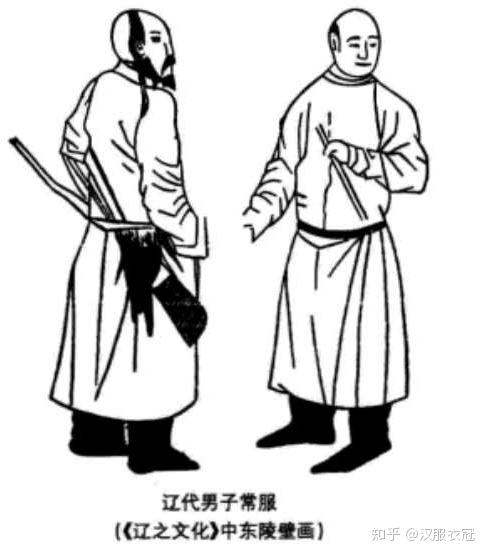
Liao Dynasty ClothingThe Liao Dynasty, established in 916 CE, was a Chinese imperial dynasty ruled under by the Khitan, a branch of nomadic Eastern Xianbei tribes. They were separated into two regions: the Northern and Southern divisions, with the Northern comprised of nomadic Khitan people, and the Southern region composed of Han and other ethnic groups. In the Liao dynasty, both Khitan and Han clothing were allowed to exist side-by-side.Clothing of the Northern Division of Liao DynastyThe Khitan clothing itself was called 國服 (guó fú, lit. 'state garments'), and the everyday clothes were called 盘裹 (pán guǒ).Liao Dynasty men's clothing consisted of narrow, round-collar robes fastened on the left (right-over-left collar), and narrow sleeves. The robe falls above the ankles, opens from the waist down on both sides, and a belt is worn. Underneath the robe is an 袄 (ǎo, 'jacket'), or a tunic; trousers are worn underneath, and tucked into boots. The colours of their robes are typically grey-green, grey-blue, brown and dark green. All layers of society wore fur coats: the wealthy wore sable fur coats, and the rest wore sheep, rat, or fox fur coats.These tight-sleeved, cross-collared round robes fastened at the left were also worn by Khitan women, as they were skilled horse riders, and their clothing had to allow adequate movement for horseback-riding and herding. They also wore round-fronted blouses in two collar styles: one with a straight collar, the other with a left-fastening collars. The skirts underneath these blouses were wide-brimmed, often black or purple, and embroidered with full-braided flowers. Underneath, cotton skirts were worn to provide layers against the cold.Han citizens of the Southern Liao Division were allowed to wear hanfu, and were not mandated to shave their heads in accordance to the shaved crown hairstyles of Khitan men.Sources: [1], [2], [3]
Hair Grooming and HairstylesIn accordance with Confucian rites, adult men and women kept their hair long. Historically, young men and women who have reached the age of adulthood—20 for men, 15 for women—underwent a coming of age ceremony, called guàn lǐ (traditional Chinese 冠禮 | simplified Chinese 冠礼), or 'capping' for men, and jī lǐ (笄禮), or hairpinning, for women. Prior to adulthood, children may cut and style their hair as they wish, however, once they were considered adults, the hair must never be cut. They kept their hair bound, and letting the hair hang loose was synonymous with impropriety and disrespect towards tradition. Even when women let their hair past their shoulders, their hair was bound or tied in a knot, seen in the Han dynasty (202 BC - 220 AD) low bun (椎髻, chuí jì, 'cudgel bun') hairstyle.Adult men tied their hair into a bun on or behind his head, and the bun was covered with a headdress, which may differ according to his social station; women shifted from simpler double buns or double loops into more elaborate hairstyles.Further reading on men's historical hairstyle here.
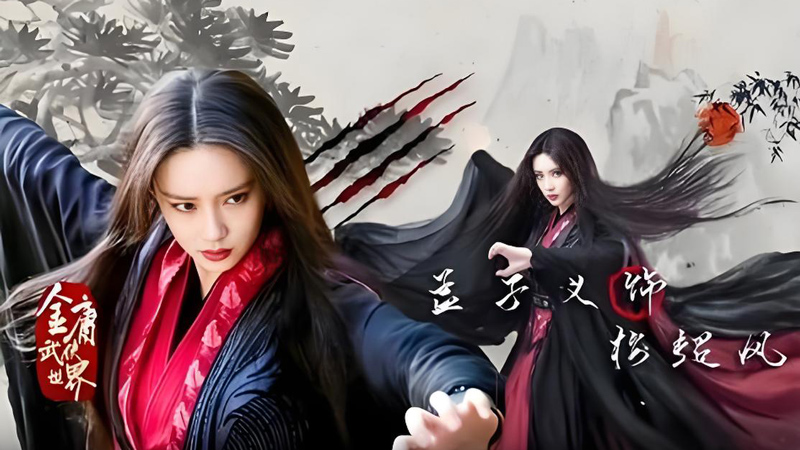
Ponytails, and half-up, half-down hair seen in historical and wuxia dramas, while not historically accurate, are allowed in this community—we are, after all, a Where Winds Meet community, influenced by the tradition of the wuxia genre, which include popular serializations from the 20th century Hong Kong onwards. However, completely loose hair (as seen in depictions of characters like Mei Chaofeng in drama adaptations of Jin Yong's Condor Heroes, examples 1, 2, or some depictions of the Eastern Heretic, Huang Yaoshi), will still be noted as 'unusual', and writers are advised to be aware of the cultural implications behind completely loose hair—they will be allowed on a case-by-case basis, given reasonable background for the character themselves. For example, eccentric or unorthodox characters, who hold no regard for traditional rites, may choose to wear their hair unbound.Our guideline may seem rigid, especially considering how the half-up, half-down hairstyle popular in Chinese historical dramas also came to be partly for aesthetic reasons—we do allow unconventional elements in characters, within reason. By presenting these guidelines, we only hope that these cultural nuances are not forgotten, or swept aside, for mere 'aesthetics.'After all, what is aesthetics for some, is a cultural heritage for others.


MakeupMakeup and makeup styles differ according to the dynasty, however, the items that could be found in a well-to-do, or a noble woman's boudoir, are not so different from what could be found on a modern day makeup table today. They had their own versions of foundation (made from lead or rice powder), eyebrow makeup (using soot from burnt willow branch), rouge made from extracts of red and blue flowers, and lip makeup made of vermilion, eventually mixed with wax and animal fats and applied with a brush.Huādiàn (花钿), flower-shaped facial accessory placed on the forehead, came about during the Tang dynasty. Historically, huādiàn was created from a variety of materials, such as paint, pearls, or gold.
Where Winds Meet Sects
We do consider the in-game Sects (Well of Heaven, Velvet Shade, etc) canon for our community lore. The only thing that differs here from the in-game sects is that we go for a far more low-fantasy or realistic approach. Some examples include:
- Silver Needle: The fan they use is not a magical healing fan, and neither is the umbrella. We prefer that they also cannot float up with the umbrella because we prefer a grounded 😉 approach to our RP. Healing is done with traditional healing methods, e.g. acupuncture, herbs, needles, moxibustion, etc.
- Velvet Shade: We prefer that they cannot float in the air with their umbrellas.
- Mohist Hill: We prefer their inventions to be more grounded in reality instead of the quite fantastical ones (spoilers)
- Hollow Vale: We prefer not to acknowledge (spoilers)
A Note on Ethnicity, Colourism, and Cultural Sensitivity
The region that makes up modern-day China has, historically, been a place where diverse ethnicities and cultures met and mingled. Tang Dynasty's Chang'an was a cosmopolitan city that welcomed merchants from Central Asia—Sogdian, Turks, Persian—all the way to South and Southeast Asia. At the height of its power, Chang'an housed 50 thousand non-Han people, including ethnic minorities of China and foreigners, out of a population of over a million.However, the old cosmopolitanism of the Tang dynasty declined following the An Lushan rebellion. By 779, restriction on foreign commerce had already begun.The time period where the game, and our stories, took place is 960 AD—three years after the end of the Five Dynasties and Ten Kingdoms era. Long after Tang's cosmopolitanism faded, and the region of the Sixteen Prefectures of Yan and Yun—where the game and this community's stories took place—no longer received visits from Central and South Asia the way it used to during the height of the Tang Dynasty.It is understandable that players and writers come from all manners of cultural and ethnic background, perhaps wishing to see parts of themselves reflected on their character. A common erroneous belief is that Chinese people—whether they are of Han descent, or other ethnic minority—cannot be tanned or dark-skinned, when in reality, melanin is common among Chinese people. This fact is not well-represented in popular media, owing to the fact that China, along with other regions in East and Southeast Asia, has historically prized light skin as a class marker —the lighter someone is, the less they need to work in the field.Players wishing to write characters who are of foreign descent—perhaps descendant of Tang dynasty merchants who settled in the Central Plains—are advised to research their character's cultural background carefully, so as to be respectful to the culture used, and to the culture where the story is set.
A Final Note
We are not historians, if there's anything we've gotten wrong please let us in know in the discord! We'll be glad to add your expertise and sources into the guidelines and rules.And once again, you DO NOT need to be an expert in Chinese culture and history to RP here! The purpose of this channel is to aggregate useful information in one place, and also to set a loose baseline for what to expect in this community. You do not need to memorize everything here, a simple read-through is enough!We welcome anyone who is respectful to Chinese culture and history and is interested in RPing in a community that loosely attempts to write within the setting and culture!
燕雲傳奇 Tales of Yanyun
FAQ
- There is no official in game guild. Members can join or make any they desire.
- There is no community plot, members are encouraged to make their own!
- If you want to make another character, please submit another application in the discord!If you have any other questions, feel free to ask in our Discord.
Click the icon below to join the Discord!
We are not the only WWM RP Community out there, and if this is not quite what you're looking for, feel free to check out other WWM RP Communities here!
Other WWM RP Communities
(If you would like your community to be added here, please join our discord and contact any of the admins!)
WWM RP Community 500+ Members | Adventure in the Jianghu!
WHAT IS THE COURT OF HARMONY?The Court of Harmony is a collaborative role-play community for Where Winds Meet. Our goal is to give players a space to create stories, develop characters, and build long form narratives that enrich the larger experience of the Jianghu. The Discord serves as a hub for text based RP using forum channels, allowing members to explore their ideas at their own pace and connect with others who enjoy the same style of play.We encourage members to participate in open forum RP, structured scenes, and long term story arcs. This community values creativity, continuity, and cooperation. Players are free to form their own circles, clans, and recurring story lines. All RP here is intended to be collaborative, inclusive, and built around shared storytelling.Guilds are welcome to establish themselves within the Court of Harmony. This space supports guild recruitment, networking, coordination, and cross guild interaction. Leaders may use the Discord to meet, plan events, and develop overarching plots that involve multiple groups.The Court exists to make it easier for players to find each other, work together, and build memorable stories. Whether you want character driven drama, guild centered politics, martial competition, scholarly intrigue, or dark and esoteric narratives, this community offers the support to bring those ideas to life.